
Drones Are Coming to Critical Infrastructure. Is Your Security Perimeter Still Only on the Ground?
11 min. read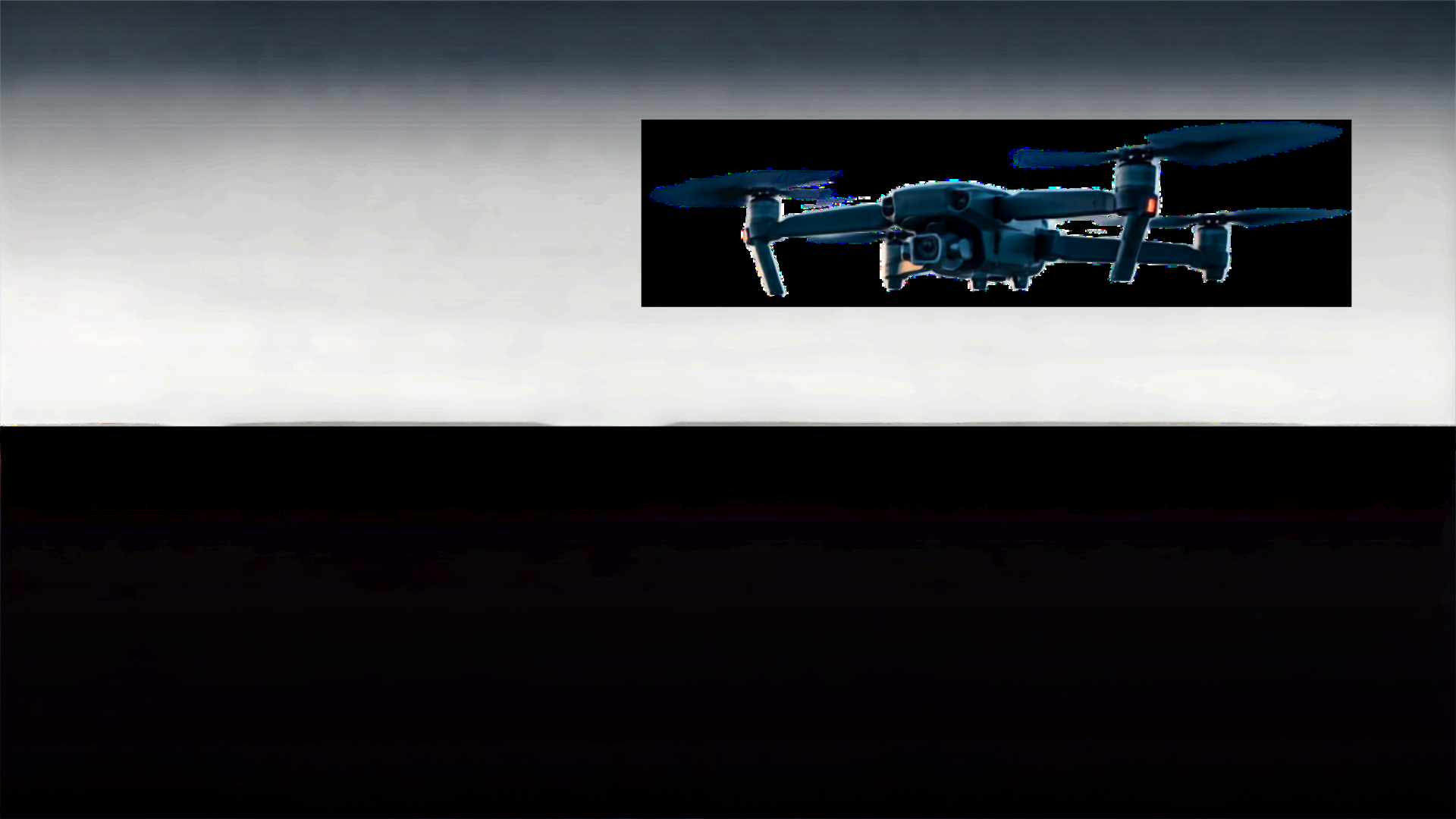
Drone flying above water utility infrastructure, representing expanded aerial security perimeters for critical facilities
For decades, protecting critical infrastructure meant controlling what crossed a fence.
That assumption is becoming outdated.
Utilities across the country are increasingly using drones to inspect power lines, assess storm damage, examine equipment, access difficult terrain, and reduce the need to place crews in hazardous environments.
In late July, Idaho Falls Power began a drone-based inspection program covering approximately 1,681 distribution poles. High-resolution cameras and thermal imaging are being used to identify damaged components, loose connections, vegetation issues, and equipment wear before they result in outages.
At the same time, the federal government and the utility industry are wrestling with the opposite side of the same technology: What happens when the drone above critical infrastructure isn't supposed to be there?
The FAA Is Rethinking the Airspace Above Critical Infrastructure
In May, the Federal Aviation Administration proposed a new process allowing certain critical infrastructure operators to request restrictions on drone flights above their facilities. The proposal recognizes a reality that utilities have been confronting for years: the airspace directly above a facility is increasingly part of its security environment.
But electric utility groups argue the current proposal does not go far enough.
On August 5, the American Public Power Association, Edison Electric Institute, Large Public Power Council, and National Rural Electric Cooperative Association jointly told the FAA that the proposed eligibility requirements would leave much of the electric grid outside the program.
Under the proposal, electric facilities would generally need to meet thresholds such as 500 megawatts of generating capacity or substations operating at 500 kilovolts before qualifying. Industry groups argue this excludes large portions of infrastructure that may still be operationally important or vulnerable.
There is another complication. Utilities don't simply want drones kept away. They increasingly want to operate drones themselves.
The Same Technology Is Both an Asset and a Security Challenge
For utilities, drones can provide enormous operational value. They can inspect lines without putting workers at height, assess storm damage before crews enter hazardous areas, examine remote equipment, carry thermal cameras across large sites, and reach infrastructure that would otherwise require vehicles, climbing equipment, helicopters, or significant labor.
Public power organizations have repeatedly advocated for regulations that make these operations easier to conduct safely and at scale.
So the security goal cannot simply be: keep every drone away.
The better question is: Can we tell when aerial activity around our infrastructure deserves attention?
That requires utilities to begin thinking vertically.
The Fence Is No Longer the Edge of the Perimeter
Most physical-security systems are designed around ground movement. Fence sensors detect climbing or cutting. Access-control systems monitor gates. Fixed cameras watch entrances. Motion detectors monitor specific areas.
Those layers remain important, but they do not fully address an aircraft approaching from above.
Radar adds another layer of awareness. Depending on the system and deployment, radar can monitor movement across large areas and cue PTZ cameras toward activity that requires closer inspection.
That creates a security workflow built around detection rather than passive observation:
Detection → Tracking → Visual Verification → Assessment → Response
The same concept can apply whether an object approaches through a perimeter or above it. The purpose is not to treat every drone as hostile — it is to give operators enough situational awareness to determine what is happening.
Detection Is Different From Interdiction
This distinction is especially important in the drone-security conversation. Detecting, tracking, identifying, interfering with, and disabling an aircraft are not the same thing, and counter-UAS activities are subject to significant legal and regulatory restrictions.
For most utilities, the immediate objective should be situational awareness:
- An unexpected aircraft appears near sensitive equipment.
- Radar or another detection system identifies the activity.
- A PTZ camera is directed toward the target.
- Security personnel evaluate what is happening.
- The event is documented and handled according to established procedures.
That alone represents a significant improvement over discovering unusual aerial activity because an employee happened to look up.
Ground and Air Security Are Beginning to Converge
The most interesting development is that drone technology can exist on both sides of this equation. An unauthorized drone may create a security concern. An authorized utility or security drone can provide another layer of visibility.
At an appropriate site, a detected event on the ground could cue cameras and potentially dispatch an authorized drone to inspect an area that fixed infrastructure cannot see clearly.
The result is a security architecture in which radar, cameras, thermal imaging, AI-assisted verification, and aerial surveillance work together rather than as isolated technologies.
That is particularly useful for infrastructure with large substations, generation facilities, solar farms, remote utility sites, storage yards, reservoirs, difficult terrain, long fence lines, or multiple unmanned assets.
Critical Infrastructure Security Is Becoming Three-Dimensional
Utilities do not need to assume every unidentified drone represents an attack. But they should recognize that the security environment has changed.
The FAA is considering new rules. Electric utilities are asking for greater protection. At the same time, those same utilities are expanding their own use of drones for inspections, emergency response, and maintenance.
That makes aerial awareness increasingly difficult to separate from physical security.
For years, the question was: Who crossed the fence?
The next generation of utility security has to ask another one: What's happening above it?
RadiusVision designs integrated security systems combining radar detection, PTZ and thermal surveillance, AI-assisted verification, and drone technologies for complex infrastructure environments. Schedule a Free Security Consultation to discuss how aerial and ground detection could fit into your utility security strategy.
Share this article: